Branding
5 AI Prompts for Branding You Can Copy and Use Today
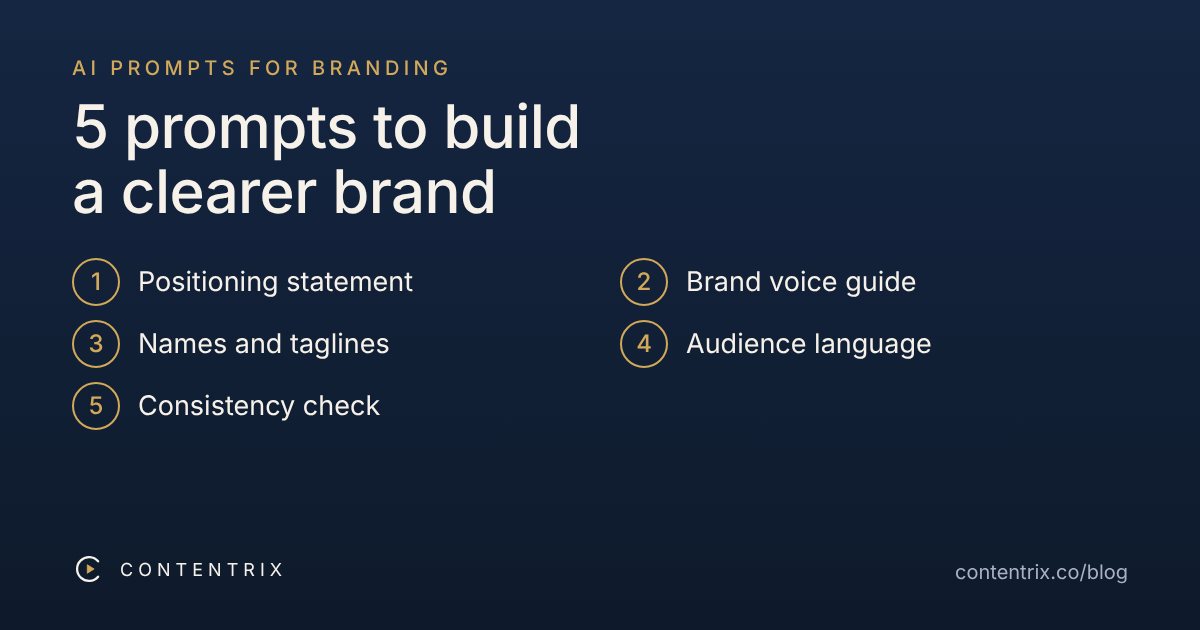
Short answer: AI is useful for branding when you give it clear input and treat the output as a draft. These five prompts cover the steps that matter most: a positioning statement, a voice guide, names and taglines, your audience's own words and a consistency check. Replace the [brackets] with your details, paste the prompt into any chatbot and edit what comes back.
How should you use these prompts?
- Fill in every [bracket] with real details. Vague input gives generic output.
- Ask for several options, then pick and edit. Do not accept the first answer.
- Use them in order. Positioning feeds the voice guide, and both feed the final check.
- Leave out confidential information such as client names and private figures.
1. Write a positioning statement
Positioning is a short sentence that says who you help, what you offer and why you are different. It is the base for everything else, so start here.
I run [type of business] in [city or market]. I help [specific audience] to [main result they want]. My main alternatives are [competitor or substitute 1] and [competitor or substitute 2]. What makes us different is [honest difference].

Write 3 positioning statements in this format: "For [audience], [brand] is the [category] that [benefit], unlike [alternative]." Keep each under 30 words. Do not use the words "leading", "innovative" or "world-class".
What to do with the answer: Pick the one that is true and specific, then ask a colleague or customer if it matches how they see you.
2. Draft a brand voice guide
A voice guide keeps captions, replies and ads sounding like one person wrote them.
Act as a brand strategist. Our brand is [one-line description]. Our audience is [audience]. Three words we want to be known for: [word 1], [word 2], [word 3].

Create a one-page voice guide with: (a) three voice traits, each with a short "we are / we are not" line; (b) 10 words and phrases we use; (c) 10 words and phrases we avoid; (d) a rewrite of this sample caption in our voice: "[paste a real caption]".
What to do with the answer: Edit the lists until they sound like you. The "avoid" list is often the most useful part.
3. Brainstorm names and taglines
Use AI for volume, then choose by hand. Most of the options will be forgettable, and that is fine.
Give me 20 name ideas for [type of business] that serves [audience]. Style: [short / warm / modern / etc.]. Rules: easy to spell, easy to say aloud, no more than 3 syllables, nothing that means something unfortunate in [your main languages].

Then write 5 tagline options for the 3 names you think are strongest, each under 7 words.
What to do with the answer: Before you fall in love with a name, search the web, social platforms and your local trademark register. A chatbot cannot confirm a name is available.
4. Find the words your audience uses
Good branding uses your customers' words, not industry jargon. This prompt works best with real material.
Below are real messages, reviews and comments from our customers. Read them and list: (1) the 10 words or phrases they use most to describe their problem; (2) the 5 things they say they value most; (3) any word they use that we do not use in our own marketing.

[paste 10 to 20 real customer messages, with names removed]

Base your answer only on the text above. If something is a guess, say so.
What to do with the answer: Do not ask for an audience persona from nothing. Without real input, the AI will invent one that sounds plausible and may be wrong.
5. Run a brand consistency check
Once you have a positioning line and a voice guide, use them to audit what you have already published.
Here is our positioning statement: "[paste]". Here is our voice guide: "[paste]".

Below are our Instagram bio, our website About text and three recent captions. For each one, tell me: (1) whether it matches the positioning; (2) where the voice drifts; (3) one specific rewrite. List contradictions between the pieces at the end.

[paste your bio, About text and captions]
What to do with the answer: Repeat this check every month or two. Brands drift slowly, and a short audit catches it early.
What AI cannot do for your brand
It cannot know your customers, check whether a name is free to use, or decide what you stand for. It also tends to sound alike across businesses, which is why the real input in prompt 4 and your own edits matter more than the prompt wording. Use AI to get from a blank page to a draft faster, and keep the decisions yourself.
Frequently asked questions
Can AI create a brand for me?
AI can draft options quickly: positioning lines, voice descriptions, names and taglines. It does not know your customers, your market or your goals unless you tell it, so treat every answer as a first draft that you edit and decide on.
Which AI tool should I use for these prompts?
Any general chatbot can run them. The prompts are written as plain text with [brackets] for your details, so they do not depend on one product. Try the same prompt in two tools and compare.
Is it safe to use an AI-generated brand name?
Not by itself. A chatbot cannot check whether a name is already trademarked or taken as a domain or social handle. Search for it yourself, and speak to a trademark professional before you commit to a name for a real business.
Should I paste confidential information into a chatbot?
Avoid it. Describe your business in general terms and leave out client names, private figures and anything covered by an agreement. Check the privacy settings of the tool you use.
How do I stop the answers from sounding generic?
Give real input: your actual customer messages, reviews and your own writing. Ask for two or three different options and say what you do not want, such as clichés or exaggerated claims.