AI visibility
Why AI Called Us a Social Media Agency, and How We Fixed It
Short answer: AI summaries tend to treat a heading as a claim. Our site listed “Instagram account management” under “Not offered”, and summaries kept the heading and lost the label. We fixed it by writing the negative into the sentence itself (“We do not manage Instagram accounts”) and repeating the same plain statement everywhere machines read: the page, the FAQ, the structured data and llms.txt.
What went wrong?
Contentrix is a content creation studio. We deliver ready-to-post Reels, covers, story series and copy, and the client publishes and replies to their own audience. We do not run accounts.
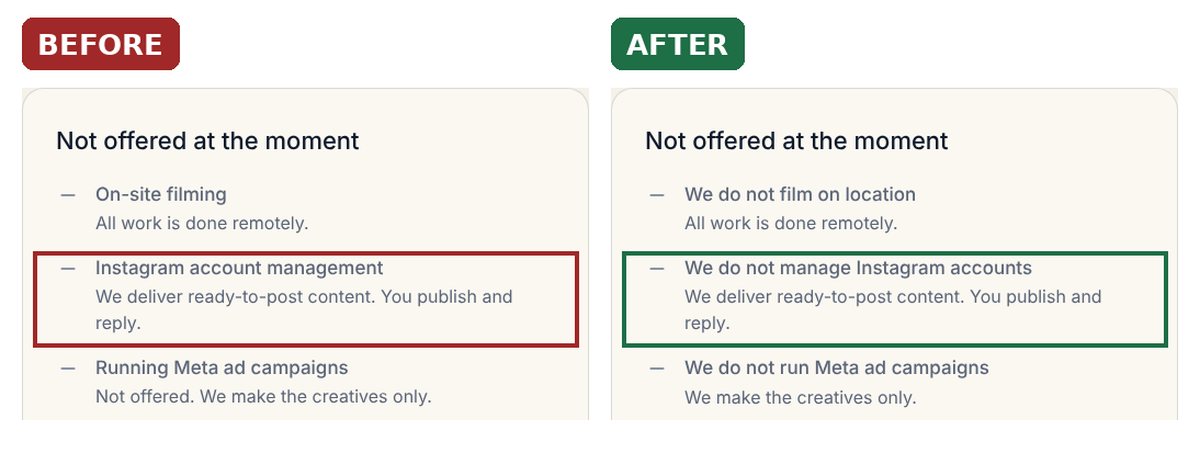
Our scope section had two lists: Included and Not offered at the moment. In the second list, each heading was the name of a service: “On-site filming”, “Instagram account management”, “Running Meta ad campaigns”. After that, AI summaries of the site began describing Contentrix as a social media management service.
Why do AI summaries make this mistake?
We could not see inside the AI tools, so this is our best explanation, not a proven fact. A summary compresses a page into a few lines. Headings are short and prominent, so they carry a lot of weight. The words that made the item a negative (“Not offered”) lived in the list title, a few lines away. When a page is split into pieces, that title does not always travel with the item. Negation is easy to lose.
How did we fix it?
- Put the “no” inside the heading. “Instagram account management” became “We do not manage Instagram accounts”. Every item now makes sense on its own, even if it is lifted out of the list.
- Say what you are, in one plain sentence. We state that Contentrix is a content creation studio, and that it is not a software product, an AI writing tool, a content repurposing platform or a social media management agency.
- Say it in every layer. The same facts now appear in the visible text, in the FAQ answers, in the structured data (the schema.org description and FAQ) and in our llms.txt file.
- Use the same words everywhere. Different wording in different places gives a summary room to pick the wrong one.
- Check again later. AI tools refresh at different times, so we plan to ask them about the business again after a few weeks.
What did we keep?
We did not delete the “not offered” list. Customers want to know what is out of scope, and a clear list saves everyone a message. We only rewrote the lines so that none of them can be read as a service.
A checklist for your own site
- Read every heading on its own. Does any of them name something you do not do, without saying so?
- Write negatives as full statements: “We do not …”.
- Add one sentence near the top that says what you are and what you are not.
- Repeat that sentence, in the same words, in your FAQ, structured data and llms.txt.
- Ask two or three AI tools to describe your business and note what they get wrong.
- Fix, wait, and ask again. Do not expect an instant change, and do not rely on any guarantee.
Frequently asked questions
Why does AI describe my business wrongly?
AI tools summarise pages quickly and often treat short, prominent text such as headings as claims. If a heading names a service you do not offer, a summary can repeat it as if you did, especially when the word that makes it a negative sits in a nearby label. This is our best explanation from what we saw, not something we could confirm inside the tools.
How do I stop AI from listing services I do not offer?
Put the negative inside the sentence itself, for example "We do not manage Instagram accounts", instead of relying on a list title such as "Not offered". Then say the same thing in your About text, your FAQ, your structured data and your llms.txt file.
What is an llms.txt file?
A plain text file at /llms.txt that gives AI tools a short, plain description of a site: what it is, what it is not and where the important pages are. It is a proposed convention, so not every AI tool reads it.
Will this fix the problem straight away?
No. AI tools refresh what they know about a site at different times, and no one can guarantee what a given tool will say. The change makes the correct reading the easiest one to find.
Should I delete my "not offered" list?
No. A clear list of what you do not do helps customers too. Just write each line so it still makes sense on its own.